
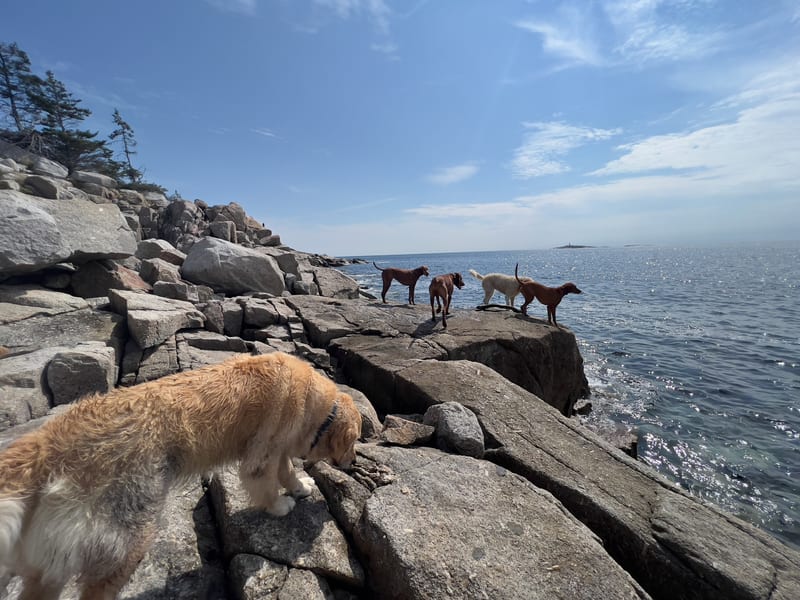
What to Expect in Your Dog's First Two Weeks of Pack Walks
When a new dog joins the 4PAWSHFX pack, they do not go straight off leash on day one. Every dog goes through an on-boarding period of about 14 days. This is not a formality — it is the foundation of a safe, well-functioning group.
Here is what that process looks like from the owner's perspective, and why it is set up the way it is.
Week one: assessment and introduction
During the first week, your dog joins the group on a long line. They can move freely, interact with the other dogs, and experience the trail — but we maintain a connection that lets us manage the situation if needed.
What we are looking for:
- Recall reliability. Does your dog respond when called, even with distractions? This is the single most important skill for off-leash safety.
- Social behaviour. How does your dog interact with the other dogs? Are they confident, anxious, pushy, or deferential? All of these are workable — we just need to understand the starting point.
- Trail confidence. Some dogs have never been in dense forest or on rocky terrain. We watch how they handle new environments and adjust the pace accordingly.
- Energy level and stamina. A dog who has never done two hours of off-leash running will be tired in a way they are not used to. We watch for signs of fatigue and manage the intensity.
Week two: building trust and testing off-leash readiness
By the second week, most dogs have settled into the rhythm of the group. They know the routine, they are comfortable with the other dogs, and they have started to look to the handler for direction rather than just following their nose.
We begin testing off-leash moments — short periods where the long line is dropped or removed — and assess how the dog responds. Some dogs are ready for full off-leash by day 10. Others need a few more days. We do not rush it.
What owners notice at home
Most owners notice two things during the on-boarding period:
- Their dog is tired. Real tired — not just "had a walk" tired. Two hours of off-leash movement through varied terrain is a different kind of exercise than a neighbourhood walk. Most dogs sleep deeply after their first few pack walks.
- Their dog's behaviour at home improves. A dog who is getting real physical and mental exercise is a calmer, more settled dog. The connection between exercise and behaviour is direct and fast.
After on-boarding
Once a dog has completed on-boarding, they join the pack as a full member. They go off leash with the group, they know the routine, and they have a place in the social structure of the pack.
From that point, the walks are consistent — same group, same trails, same handler. Dogs thrive on that kind of routine.
What if my dog does not pass on-boarding?
It is rare, but it happens. If a dog is not safe off leash with the group — due to aggression, extreme prey drive, or recall that cannot be reliably established — we will tell you honestly and recommend an alternative path. That might be private training first, or a different type of care that suits them better.
We would rather have that conversation than put a dog or the group at risk.
If you are thinking about pack walks for your dog, the first step is a meet and greet. Learn more about our pack walks or contact us to get started.